Start with the basics
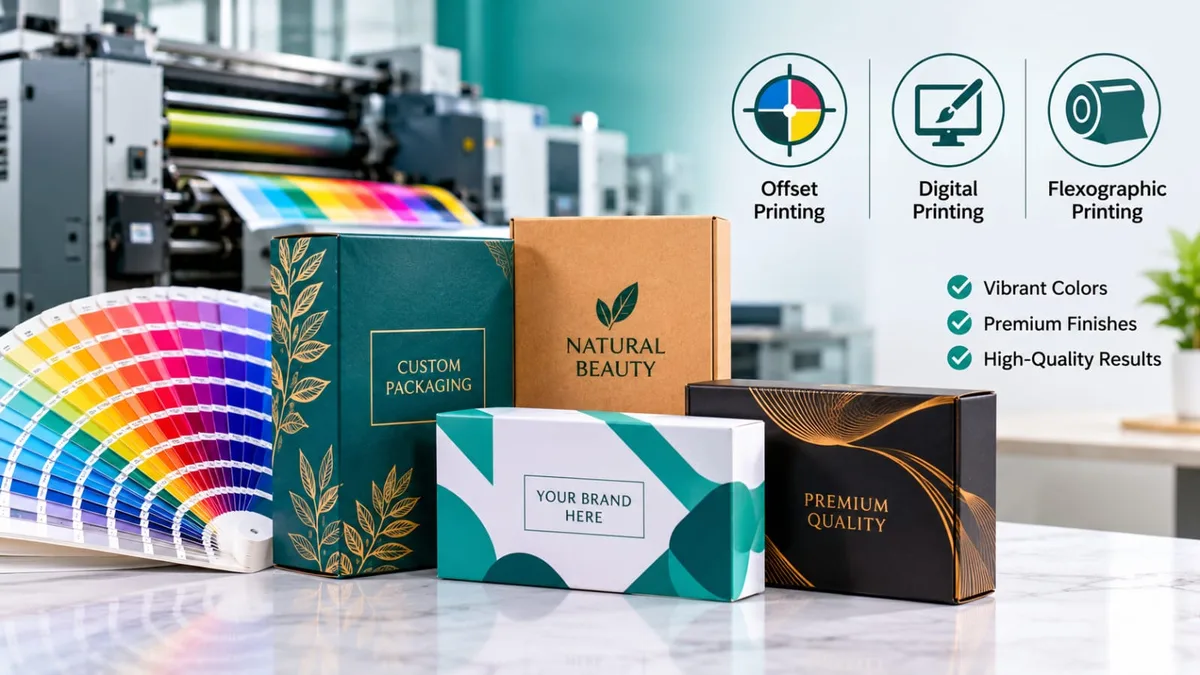
Printing is the part of packaging that carries your brand: your logo, your colors, your product name, and the information a buyer reads on the shelf. A printing method is simply the way ink is put onto the board. Different methods suit different box styles, artwork, and runs, which is why CPP matches the method to your run rather than offering one method for everything. The three printing methods CPP lists are offset, digital, and flexo. Each one is described below in its own section, with the box styles it is commonly used for. Final printing choice is confirmed during quoting, based on your box, artwork, and quantity.
Offset Printing
Offset printing gives sharp detail and consistent color across large areas. It is commonly used for folding cartons and rigid-box wraps, where clean artwork and steady color matter across the whole run. Offset suits brands with detailed artwork, logos with fine lines, and designs that need to look the same from the first box to the last. Because it is set up for consistent color over large areas, it is a natural fit for retail cartons and premium wraps rather than a one-off test print. Visually, think printed paperboard sheets with detailed graphics, and premium folding cartons. See Tuck-End Carton for a folding carton example, and Magnetic Rigid Box for a rigid-box example.
Digital Printing
Digital printing is flexible for shorter runs and variable designs. It suits brands that are testing a design, printing a small run, or changing artwork between versions, because the design can vary without the setup of a longer run. Digital is a candidate option confirmed per project, so final availability is confirmed during quoting rather than promised for every box and every run. If your run is short, or if you want to try more than one design, digital is the method to ask about first. Visually, think short-run customized printed packaging with variable artwork. Share your artwork and quantity in the quote process and the method is confirmed for your project.
Flexographic Printing
Flexographic printing, usually shortened to flexo, is efficient for corrugated volumes. It is commonly used for shipping boxes and mailers, where the box needs clear branding that survives handling and transit. Flexo suits e-commerce brands, subscription boxes, and shipping lines that print the same design across many boxes. The focus here is practical: a clean logo, a clear brand mark, and readable information on a box that is built to travel. Premium corrugated packaging can also use other print workflows — flexo is the common choice for corrugated volumes, not the only suitable method. Visually, think corrugated board moving through a flexographic printing production line. See Corrugated Shipping Box for a corrugated shipping example, and Custom Mailer Box for a mailer example.
Packaging comparison
Here is how the three printing methods compare, so you can shortlist the right one for your boxes.
| Type | Best suited for | Artwork | Setup | Color consistency | Typical application |
|---|
| Offset | Folding cartons and rigid-box wraps | Detailed graphics | Printing plates | Excellent with controlled setup | Retail packaging |
| Digital | Shorter runs and variable designs | Variable designs | Digital setup, no plates | Depends on equipment and calibration | Test runs and custom runs |
| Flexo | Corrugated volumes, shipping boxes and mailers | Bold, simple artwork that reads well on corrugated | Flexible plates | Suits bold color on corrugated; exact result confirmed during quoting | Shipping boxes, mailers and e-commerce volumes |
No universal MOQ or price comparison is given here — actual economics depend on equipment, dimensions, print coverage and quantity, and price is confirmed during quoting. If you are torn between two methods, a sample of each settles it faster than guessing.CMYK vs Pantone
CMYK printing uses Cyan, Magenta, Yellow and Black to reproduce a wide range of colors. It is common for photographic and full-color artwork. Pantone printing uses standardized spot-color references to help achieve specific brand colors consistently, subject to the chosen printing process and substrate. Note that colors on screen may differ from the final printed result — check the proof before approval.
Color coverage: full color or one or two colors
Color coverage is separate from the printing method. Full-color printing suits photographic designs and bright brands, where the artwork needs many colors at once. One-color or two-color printing suits minimal, natural brands and can offer a simpler, cost-conscious printing approach. Fewer colors does not change how much board your box uses — it changes how simple the artwork setup is, not the material. Pick color coverage to match your design: bright and photographic goes full color, clean and minimal goes one or two colors. The site's specifications panel also shows CMYK and Pantone styles — final color handling is confirmed during quoting, based on your artwork. See Window Boxes where print and product are both visible through the window, and Sleeve Boxes where print carries the branding around the product.
Printing on different packaging materials
Printing choice is matched to the box and the material, not just to the artwork. Folding cartons and rigid-box wraps commonly use offset, where sharp detail and consistent color matter. Corrugated shipping boxes and mailers commonly use flexo, where efficiency across corrugated volumes matters. Shorter runs and variable designs commonly use digital, where flexibility matters more than a long setup. Printing requirements also differ across materials: paperboard and folding cartons, rigid box wraps, corrugated board, kraft paper, flexible packaging, and labels and packaging accessories. The suitable process depends on the substrate, construction and available production method, and is confirmed during quoting — offset, digital and flexo are the three methods CPP lists, not the only printing technologies that exist. Board choice also matters: kraft has a natural, uncoated look that suits simple printing, but kraft does not automatically mean eco-friendly, and final material and recyclability details are confirmed during quoting, since coatings and finishes affect recyclability. Coated boards suit bright, vibrant print, while uncoated boards suit a natural, understated look. In short: match the method to the box style, material and run first, then match the board to the look you want, and confirm both during quoting.
Finishes that change the look
Finishes are not printing methods. They are added after printing to change how a box looks and feels. Matte Finish gives a soft, non-reflective surface that feels natural and understated. Gloss Finish gives a bright, shiny surface that makes colors pop. Gold Foil Stamping adds a metallic gold logo or accent for a premium hit. Embossing adds a raised texture you can feel, giving depth to logos and patterns. Debossing presses the design into the board for a subtle, recessed effect. Spot UV adds a shiny coating to selected areas only, so one part of the design stands out against a matte background. Spot UV is not necessarily raised — it can be a smooth, glossy spot coating too. Coating and lamination protect the print and change the surface feel. Pick one or two finishes, not all of them — a single foil logo on a matte box often looks more premium than every finish at once. Final finish availability is confirmed during quoting, since finishes affect recyclability and must suit your board and artwork. See Gift Boxes where premium finishes are often used to make a gift box feel special.
Artwork and proof
Good printing starts with good artwork. CPP prefers an editable Adobe Illustrator file, but any editable format works. Before sending artwork, check this list: editable Adobe Illustrator (.AI) file preferred; PDF artwork accepted where suitable; correct dieline and dimensions; CMYK or Pantone color specifications; fonts outlined or supplied; linked images embedded or supplied; bleed and safe area confirmed; spelling, logo placement and artwork approved. Share your artwork in the quote form if you have it. If you do not have artwork, design support is part of the quote process. Before production starts, you will see a proof, and production will not start without your approval. CPP will also try to show you a 3D mockup. Three things are different: a digital artwork proof shows your artwork as it will print; a 3D mockup shows the shape of the finished box; a physical printed sample is an actual printed box, available at an additional cost — see the sample question below. Check the proof for spelling, colors, logo placement, and box size before approving — a proof approved in haste is hard to fix after printing starts. If anything looks wrong on the proof, say so before approval, not after production. Exact accepted file formats are confirmed during quoting.
How to choose your printing
Match the method to four things: your box style, your artwork, your run, and your budget. A folding carton or rigid wrap with detailed artwork points to offset. A short run or a design that will change points to digital. A corrugated shipping box or mailer printed in volume points to flexo. Then match color coverage to your design: photographic and bright goes full color, minimal and natural goes one or two colors. Then pick one or two finishes that suit the brand, not every finish at once. Finally, confirm the method, board, finishes, and size during quoting, and check the proof before approval. If you are not sure yet, share your box type and artwork in the quote process and the method is matched to your run.
Common mistakes to avoid
First, do not choose a method by name alone — match it to your box style and run, or the print may not suit the board. Second, do not assume fewer colors means less material — color coverage changes artwork setup, not board use. Third, do not skip the proof — printing without proof approval risks spelling, color, and placement errors that cannot be undone cheaply. Fourth, do not stack every finish at once — too many finishes can fight each other and hide the design. Fifth, do not assume a printed box is automatically recyclable — coatings, laminations, adhesives, and other finishes can affect recyclability, so check the specifications of your selected packaging. Sixth, do not promise yourself a method before quoting — digital in particular is confirmed per project, so confirm availability for your box and run first.
Getting a quote: what to share
To get printing matched to your boxes, share your box type, size, quantity, printing choice, stock, add-ons, artwork if you have it, and your email address, which is required so the quote can be sent by email. If you do not have artwork, or you are not sure about size or printing yet, tick 'Not sure yet' and design support is part of the quote process. The estimation team prepares your quote and replies by email. No price is given in this article, because price depends on box style, size, quantity, printing, stock, add-ons, and finishes, and is confirmed during quoting. Ready to print your boxes? Request a quote with your box type, size, quantity, and printing choice — or tick 'Not sure yet' and we will help you choose.
Related Products and Articles
Related reading: Custom Soap Boxes: 8 Creative Ideas for Your Brand — for printing and finishes on soap boxes. Mailer Box Dimensions Guide — for sizing shipping boxes before printing. Browse all products: Products.
Get the Right Printing for Your Custom Packaging
Get the Right Printing for Your Custom Packaging. Whether you need detailed retail printing, flexible short-run production or branded corrugated shipping boxes, CPP helps you select suitable packaging, materials and finishes for your brand. Request a Custom Quote with your box type, size, quantity, and printing choice — or tick 'Not sure yet' and we will help you choose. ---